
The Discovery of the Ethical Life
The Well at the Center of the Village is a parable about the moral and spiritual center that quietly shapes the whole life around it. As the village discovers, disorder cannot be healed only by fixing the outer edges; the source of renewal lies in clearing and restoring the center. The story reveals one of the deepest teachings of The Harmony Code: when the center is neglected, the field around it begins to distort, but when the center is purified, life can gather again in trust, care, beauty, and harmony.
The Well at the Center of the Village
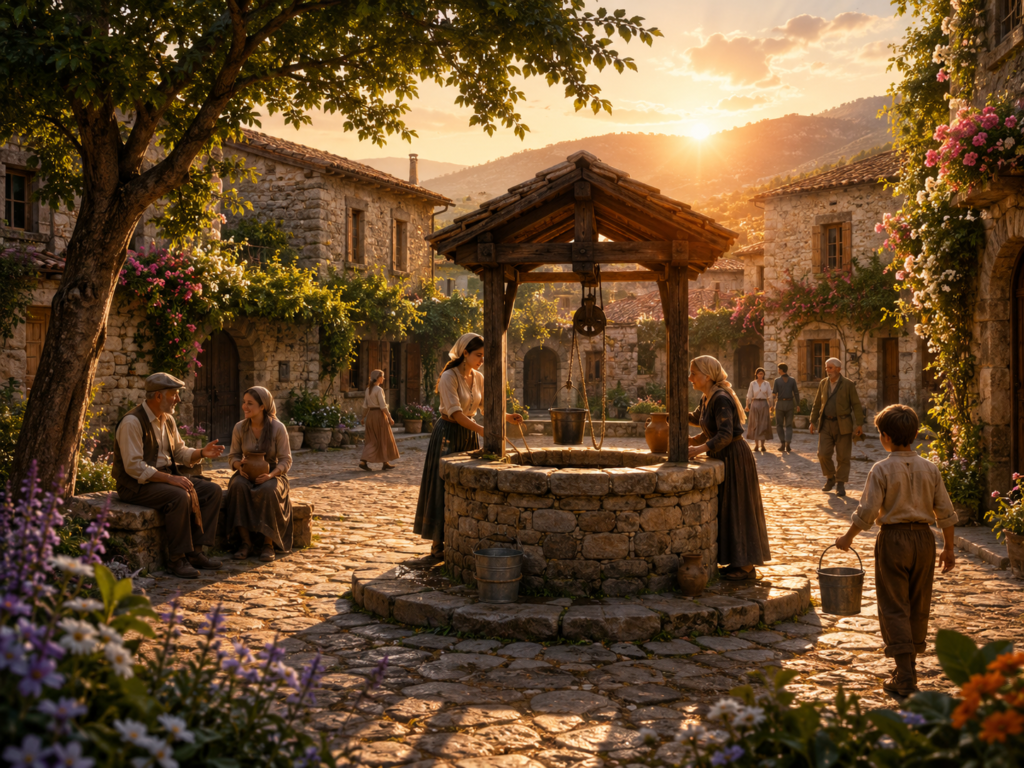
There was once a village built around a well.
The well stood in the center square beneath an old tree. In the mornings, people came to draw water. Children played nearby. Elders sat in the shade. Travelers stopped to rest. Neighbors exchanged news, shared food, settled disputes, and celebrated births, marriages, and harvests.
The well gave more than water. It gave the village a center.
For many years, the people cared for it. They swept the stones. They covered it during storms. They taught their children not to throw anything into it. They gave thanks before drawing water.
And because the well was clean, the village was alive.
But over time, the people became busy.
Some hurried to their work and forgot to cover the well. Some threw scraps nearby. Others argued in the square and left in anger. Leaves fell in. Mud gathered. A cracked bucket was left to rot beside it.
At first, the change was small.
The water tasted slightly bitter.
Then people stopped lingering in the square. The children were told to play elsewhere. Neighbors drew water quickly and returned home. The elders stopped sitting beneath the tree. Travelers passed through without staying.
Soon, the village began to change.
People argued more often. The market grew quiet. Houses became neglected. Families complained that something was wrong, though no one could name it.
So the village council met.
One person said, “We need new roads.”
Another said, “We need stronger rules.”
Another said, “We need to punish the troublemakers.”
Another said, “We need to repaint the houses.”
For months, they tried everything.
They repaired fences.
They changed market hours.
They scolded the children.
They wrote new rules.
They blamed neighboring villages.
They blamed the weather.
They blamed one another.
Nothing changed.
Finally, an old woman who had lived in the village longer than anyone stood up.
“You are trying to fix the edges,” she said, “but the sickness is at the center.”
The council fell silent.
She walked to the well and removed the broken cover. The smell rose at once. Leaves, mud, scraps, and insects floated in the water.
“This is what you have been drinking,” she said. “This is what you have gathered around. This is what you have neglected.”
The villagers were ashamed.
The next morning, the old woman came with a broom, rope, bucket, brush, and clean cloth.
At first, she worked alone.
Then one child joined her.
Then a mother.
Then two farmers.
Then the baker, the carpenter, and the schoolteacher.
They cleared the leaves. They scrubbed the stones. They repaired the cover. They cleaned the square. They planted flowers around the old tree. They made a new rule — not a rule of punishment, but of reverence:
What gives life must be kept clean.
For several days, the water remained cloudy.
Then, slowly, it cleared.
The first morning the water ran sweet again, the old woman drew a bucket and poured it into a clay cup. She handed it to the youngest child.
The child drank and smiled.
Soon the village began to return.
People lingered in the square. Elders sat beneath the tree. Children played nearby. Travelers stopped again. The market revived. Disputes softened because people were meeting one another at a clean center.
One day, a traveler said to the old woman, “You restored the village.”
She shook her head.
“No,” she said. “We restored the well water at the center. The village remembered what to do after that.”
A young man asked her, “Is every village like this?”
She answered, “Every life is like this.”
He did not understand.
So she continued.
“Your words gather around the center of your mind. Your actions gather around the center of your heart. Your family gathers around what it loves. Your work gathers around its purpose. Your society gathers around its values. If the center is clouded, the field will suffer. If the center is cleared, the field can heal.”
The young man looked at the well.
“So the work of life is to clean the center?”
“Yes,” said the old woman. “Again and again.”
“What should we place there?”
She looked at the children, the tree, the water, and the people gathered in the square.
“Truth,” she said. “Goodness. Beauty. Balance. Gratitude. And above all, love.”
The village never became perfect.
People still argued. Storms still came. Buckets still broke. Leaves still fell.
But from that time on, whenever the village became troubled, the people knew where to look first.
Not to the edges.
To the center.
Core Teaching
The quality of the center shapes the quality of the whole. This is the ethical heart of The Harmony Code. If we want more harmony in life, relationships, families, communities, and societies, we must begin by clearing and purifying the centers from which they form.
This parable reflects the later sections of Jin’s book Heart of the Universe, where the center-field principle is applied to human life, including thoughts, words, relationships, family, society, values, and humanity’s treatment of nature. The manuscript specifically emphasizes that the “way of the whole organism goes the way of its core.”
Recite the Sutra
- What is placed at the center shapes what gathers around it.
- A pure center creates a clear field.
- To change the world around you, begin with the center within you.
Reflection Questions to Consider
What is the “well” at the center of my life right now?
What have I allowed to fall into it?
What center in my family, work, or community needs clearing?
What gives life and therefore must be kept clean?
Take One Step Closer
Choose one center today and clean it.
A physical center: your desk, room, kitchen, altar, garden, or doorway.
A relational center: a conversation, apology, truth, or act of kindness.
A mental center: a recurring fear, resentment, or false motive.
A spiritual center: a moment of prayer, gratitude, nature, or return.
Say:
What gives life must be kept clean.