The Flower That Revealed the Code
This parable shows how a simple flower can become a doorway into the deeper pattern of creation. By observing its center, radiating petals, symmetry, beauty, and quiet order, the parable reveals the core insight of The Sacred Source Code: life forms around centers, fields extend outward, patterns gather into wholeness, and harmony appears as evidence of a deeper intelligence at work. The flower is not only beautiful — it is teaching the Source Code written into nature.
The Discovery
One morning, a student came to Jin with a troubled mind.
“I have read many books,” the student said. “I have listened to teachers, watched the world, studied science, and prayed in silence. Still, I do not understand how life becomes beautiful. Why does nature feel so right? Why does a flower, a tree, a river, or a galaxy seem to belong to a greater order?”
Jin smiled and said, “Then let us not begin with books. Let us begin with what is before us.”
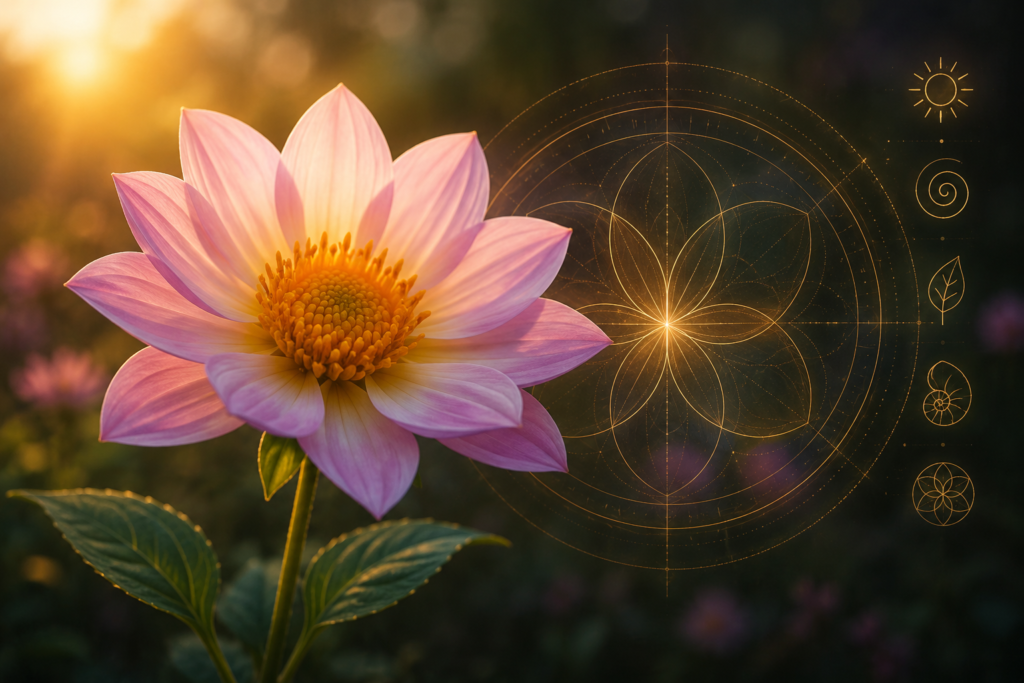
They walked to the edge of a garden where a single flower had opened after the night’s rain. Dew rested on its petals. Its color seemed to glow from within.
“What do you see?” Jin asked.
“A flower,” said the student.
“Look again.”
The student bent closer. “I see beauty.”
“Good. But beauty is often the doorway. Walk through it.”
The student studied the flower more carefully. The petals were not scattered randomly. They opened from a common point. Each one seemed to belong to the others. The flower was many, yet somehow one.
“I see order,” the student said. “The petals gather around a center.”
Jin nodded. “And what does that center do?”
“It holds the form together.”
“Yes. The center does not shout. It does not chase the petals. It simply holds the pattern from which the whole flower opens.”
They walked farther and came to a tree. Jin pointed to its trunk.
“Where does the tree gather?”
“At the trunk,” said the student.
“And below?”
“At the roots.”
“And where did it begin?”
“In a seed.”
The student paused.
“So the tree also began from a center.”
“Yes,” said Jin. “A seed became roots, trunk, branches, leaves, flowers, fruit, and shade. A small center became a world.”
They continued to the stream. Water from many small channels gathered and flowed toward a common mouth. They looked upward. The sun held planets in their paths. They spoke of atoms gathered around nuclei, cells formed around living instructions, families gathered around children, villages around wells, stories around meanings, and nations around symbols.
Again and again, the student saw the same pattern:
a center,
a field,
a forming whole.
By afternoon, the student sat beneath the tree in silence.
“I think I understand,” he said. “Nature is not merely beautiful. It is organized beautifully.”
Jin smiled. “And what organizes it?”
“Centers.”
“And what do centers create?”
“Fields.”
“And what do fields gather?”
“Worlds.”
Jin picked up a fallen flower and placed it in the student’s hand.
“This is the first doorway of The Harmony Code. Nature is not only scenery. Nature is living scripture. It has been teaching us from the beginning.”
The student looked at the flower again. It no longer seemed like a small thing. It seemed like a sentence written by the universe.
“What does it say?” Jin asked.
The student answered slowly:
“From the center, the world is formed.”
Jin nodded.
“And now ask the harder question.”
“What question?”
“If flowers, trees, rivers, stars, cells, families, and societies all form around centers, what is forming around the centers of your own life?”
The student lowered his eyes.
“My thoughts. My words. My choices. My desires. My fears. My loves.”
“Yes,” said Jin. “These too are centers. They create fields. They gather your life around them.”
The student held the flower quietly.
“Then if I want my life to become beautiful, I must look first at what I have placed at the center.”
“That is the beginning of wisdom,” said Jin.
The flower had revealed the Code.
Not by argument.
Not by doctrine.
But by being what it was.
A center.
A field.
A forming whole.
A small world of harmony.
Teaching
Nature reveals the pattern of creation. Again and again, life forms around centers. When the center is clear, living, balanced, and whole, beauty and harmony can form around it.
This parable draws from the Heart of the Universe dialogue in which Jin and Mo observe nature’s “rightness,” study a flower’s symmetry, then discover the central role of centers, origins, fields, and harmonious form in nature’s creative process.
Sutras
From the center, the world is formed.
Nature is living scripture.
What is placed at the center shapes what gathers around it.
Reflection Questions
What natural form has recently taught me something?
What centers are shaping my life right now?
What would change if I treated nature as living scripture?
What is one field forming around me that needs a clearer center?
One Step Closer
Choose one natural object today — a flower, tree, stone, stream, leaf, cloud, or shell. Sit with it for five minutes and ask:
What center holds this form together?
What is it teaching me about my life?